Advanced Dog Training Guide: Off-Leash, Tricks, Agility & Specialized Skills
The Science of Advanced Dog Training: Off-Leash Reliability, Agility Biomechanics, and the A.R.C.S. Method
Why does a dog perform advanced skills perfectly in the backyard, then ignore the exact same cue off-leash or around other dogs? Because dogs are highly situational learners, and advanced reliability only happens when I teach the behavior, the environment, and the post-training window as one system.
Most guides stop at “be consistent,” “use high-value treats,” or “practice more.” That’s not enough when you’re dealing with a dog that can run a full agility sequence, find odor in one room, or heel beautifully on leash — and then fall apart the second the context changes. What I see in real training is that the breakdown usually isn’t the cue itself. It’s generalization, arousal, body language, or what happens after the session ends.
This page is built for the whole arc: if you’re just starting to stretch beyond basic obedience, if you’re comparing methods, if you’re deep in the weeds and nothing is sticking, or if something worked and then quietly fell apart. I’m going to walk through the actual mechanics I use with clients: how dogs store learning, how I build off-leash reliability, how I think about agility force and handler movement, and why scent work can go sideways when the alert gets reinforced too early.
Cognitive Foundations of Advanced Learning
Advanced training is mostly about making a behavior survive context changes, not just teaching the behavior once.
Why a dog can know a skill and still fail it somewhere new
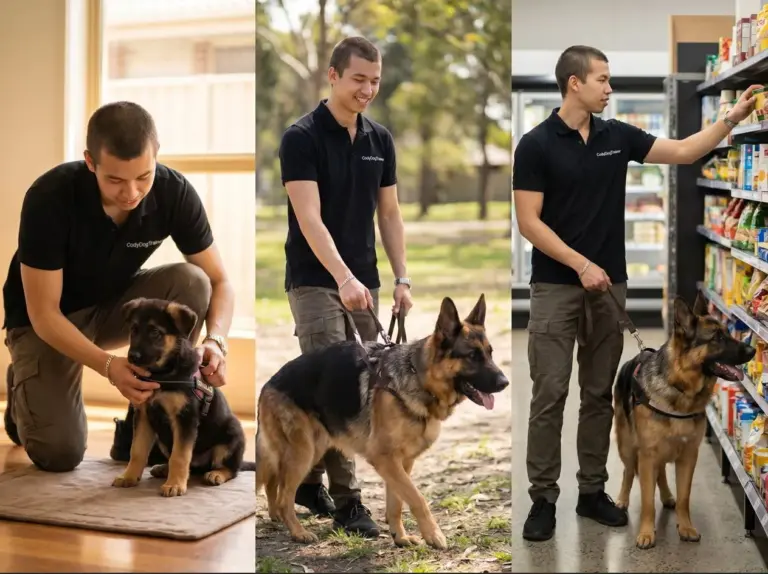
Dogs do not learn cues as abstract, universal rules the way people often assume they do. They learn in context. The room, the handler’s posture, the smell of the floor, the spacing between reps, the emotional state of the dog — all of that gets bundled together with the cue.
That’s why a dog can “know” sit in the kitchen and still look confused in the park. The command didn’t disappear. The meaning got narrowed to the original setting.
When I’m working with clients, I treat this as a generalization problem, not a disobedience problem. If the dog can do it in one place but not another, I don’t ask, “Why is he being stubborn?” I ask, “What changed enough to make the behavior stop paying off?”
The cleanest way to build generalization is to vary one thing at a time:
- Distance: how far I am from the dog
- Duration: how long the dog has to hold the behavior
- Distraction: how much is happening around the dog
If I increase all three at once, I usually get failure and confusion. If I change one variable, the dog has a fair chance to understand what still matters.
That’s the difference between a skill that looks good in a lesson and a skill that survives real life.
The myth of generalized self-control
One of the biggest misconceptions I see is the idea that sports training automatically creates general impulse control.
It doesn’t.
A 2025 study in Animals found no performance difference on cognitive self-control detours between sports-trained dogs and pet dogs, and barn hunt dogs actually scored significantly lower. That matters because it tells me something important: being excellent at agility, scent work, or barn hunt does not magically make a dog better at novel self-control tasks.
I see this all the time in the field. A dog can hold a beautiful start-line stay under trial pressure and still explode toward the front door when a guest arrives. Those are not the same skill. They may look related, but they live in different contexts in the dog’s brain.
So when a client says, “He’s great in class, but he won’t listen at the trailhead,” I don’t treat that as a contradiction. I treat it as a sign that the dog has learned a very specific version of the behavior.
If you want self-control outside the sport, you have to train it outside the sport.
What I actually do to generalize a behavior
When I want a cue to hold up in the real world, I build it in layers:
- Teach it where the dog can win
I start in a low-distraction space where I can get clean reps and the dog can succeed without guessing. - Change the environment before changing the difficulty
I move the behavior to a different room, then outside, then around mild movement, then around bigger distractions. I don’t jump from living room to crowded park and act surprised when the dog falls apart. - Keep the reinforcement strong while the context changes
A lot of people reduce rewards too early. That’s where reliability gets brittle. I want the dog to understand that the cue pays across environments before I make the reward less predictable. - Proof the behavior under real pressure
Only after the behavior is stable do I add the kind of distraction that actually matters: dogs, wildlife, movement, odor, food, or noise.
This is the part most people skip. They think generalization is a side effect of repetition. In my experience, it’s a separate training job.
The “Do as I Do” protocol is useful for complex work
For some dogs, especially smart, socially tuned ones, I can teach complex routines faster by using imitation instead of only shaping every detail.
The Do as I Do protocol uses the dog’s natural tendency to watch and copy human movement. A 2014 study in Applied Animal Behaviour Science found that Do as I Do outperformed traditional operant shaping for teaching complex sequences and multi-step object interactions.
I like this approach when the behavior has a lot of parts, like:
- a multi-step retrieve
- a chained trick routine
- a directional search pattern
- a sport sequence with several transitions
The reason it works is simple: some dogs learn faster by observing than by being clicked through every tiny approximation.
How I use social learning in real sessions
I don’t use imitation for every dog or every behavior. I use it when the dog is socially attentive and the task has multiple parts that would otherwise take forever to shape.
A simple version looks like this:
- I show the dog the behavior.
- I mark the dog’s attention to my action.
- I reward the dog for matching the action.
- I repeat with one step at a time until the dog can copy the routine.
This is especially helpful for handlers who get stuck in endless shaping loops. If the dog already watches you closely, use that. Don’t fight the dog’s learning style.
Where this usually breaks down
The biggest failure point I see is when people confuse “the dog understands this in training” with “the dog owns this behavior.”
Those are different things.
A dog may understand a cue, but still lose it when:
- the environment changes too fast
- the reward rate drops too soon
- the handler gets tense
- the dog is under-slept or over-aroused
- the behavior has only ever been practiced in one emotional state
That’s why I don’t build advanced reliability by adding more pressure first. I build it by expanding the dog’s ability to perform the same behavior in more places, with more emotional control.
If you want the basic mechanics of this in a lower-intensity setting, my scent work introduction drills for bored high intelligence dogs are a good place to see how I build search focus before I ask for harder discrimination.
The A.R.C.S. Method: how I lock learning in after the session ends
The session is only the first third of learning. What happens right after training matters just as much.
Why sleep changes retention
Learning doesn’t stop when I put the leash away. The brain keeps organizing what just happened.
A 2017 Scientific Reports study found that undisturbed post-training sleep changes EEG power in dogs: delta activity increases in NREM sleep, and relative theta activity increases during REM sleep. The same body of work links sleep spindle density to better post-sleep performance.
That lines up with what I see in practice: dogs that get a clean learning session, then a calm recovery window, tend to hold onto new work better than dogs that go straight from training into chaos.
I’m not saying sleep is magic. I’m saying it’s part of the training plan.
Why post-session play helps
A 2017 study in Physiology & Behavior found that 10 minutes of social play with a human after training reduced relearning trials from 43 to 26 24 hours later, and the benefit was still measurable later on.
That’s not a small difference. That tells me the emotional state after training changes how the dog tags the learning.
I use that all the time with dogs that need a clean finish. A short tug session, fetch, or other interactive play can help the dog leave the lesson in the right state — excited, connected, and ready for the next phase of consolidation.
The key word is interactive. Solo toy play is not the same thing. I want the dog engaged with me.
The A.R.C.S. framework
I use the Arousal-Regulated Consolidation System (A.R.C.S.) when I want a skill to stick without drilling the dog into mental mush.
It has three parts:
1. Cognitive Encoding
I keep the active lesson short — usually no more than 10 minutes. I teach one thing, keep the reward clear, and end on a success.
2. Noradrenergic Tagging
Within about 10 minutes of the session, I follow with 10 minutes of high-intensity social play. This is where I want the dog’s arousal to rise in a positive way. That state helps tag what just got learned.
3. Neural Replay
After play, I give the dog a quiet, low-stimulus rest window — ideally around three hours of undisturbed sleep or deep rest.
That sequence matters because it respects how learning stabilizes biologically. If I train, then immediately flood the dog with noise, movement, or another hard lesson, I’m stacking interference on top of fresh memory.
What this looks like in a real day
A clean A.R.C.S. day might look like this:
- 8–10 minutes of focused recall work
- 10 minutes of tug or fetch with me
- crate time or a quiet room
- no extra drilling, no social chaos, no “let’s just work on one more thing”
If the dog is young, stressed, or easily overstimulated, I’m even more careful. The goal is not to exhaust the dog. The goal is to make the learning survive.
Where people mess this up
The most common mistake is trying to train until the dog is tired and then assuming fatigue equals learning.
It doesn’t.
Fatigue can hide mistakes. It can also make a dog shut down, especially a sensitive one. I’d rather do one clean 8-minute lesson and let the brain do its job than squeeze 25 messy reps out of a dog who stopped processing 10 minutes ago.
This is especially important for working dogs that need clean indication, clean recall, or clean obstacle commitment. If you want more structured work that respects the dog’s body and brain, my three phase mobility support training for certified assistance dogs shows the kind of progression I use when physical reliability matters.
The biomechanics of the canine athlete matter more than most handlers think
If the dog’s body can’t absorb the work, the training plan isn’t finished yet.
Why speed changes force
The faster a dog moves, the more force the body has to manage on landing and turning.
In biomechanics, kinetic energy rises with speed, and that means a small increase in velocity can create a much bigger load on the limbs. In plain English: a dog that looks “just a little faster” may be taking a lot more impact.
That matters in agility, especially on contact obstacles and sharp directional changes.
Running contacts are not automatically easier on the body
This is where I push back on a common assumption.
A 2024 study in Ciência Rural found that Peak Vertical Forces on landing are significantly higher in fast dogs and in dogs using running contacts compared to stopped 2o2o contacts.
That doesn’t mean running contacts are bad in every case. It means they are not automatically the safer option just because they look smoother.
I hear people say running contacts are gentler because the dog doesn’t slam on the brakes. But from a force perspective, the landing load can be higher. That’s the part handlers need to understand before deciding which technique to teach.
What I watch for in contact work
When I’m evaluating a dog on contacts, I’m looking at:
- how the dog decelerates
- whether the dog can stay balanced at the end of the obstacle
- whether the dog is overreaching or stuttering
- whether the handler’s speed is forcing the dog to overcommit
- whether the dog is landing cleanly or crashing through the front end
A lot of contact problems are not really contact problems. They’re speed-management problems.
How I teach contacts without guessing
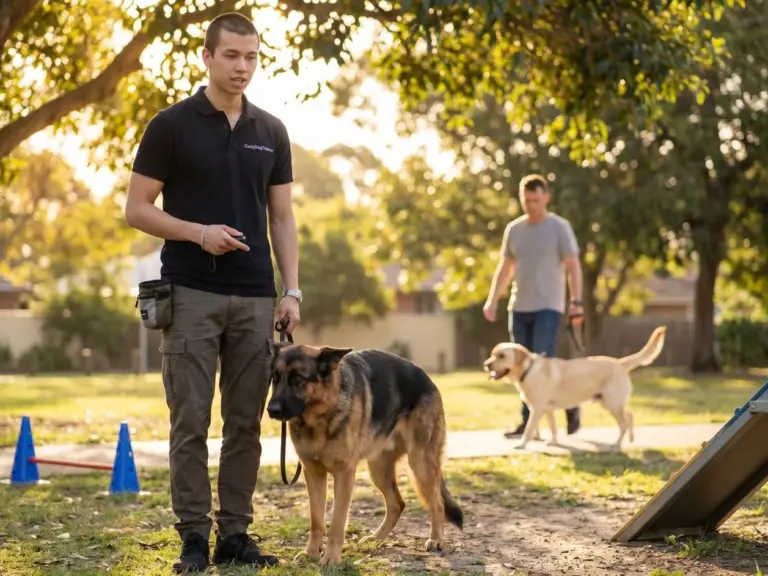
I like to build contact behavior on the flat first:
Rear-foot target work
I may start with a target mat so the dog learns where the feet belong.
Plank transfer
Then I move to a low plank or board so the dog learns the same pattern on a real surface.
Proofing under motion
Only after that do I add speed, handler movement, and distraction.
If the dog is consistently flying off the end, I don’t just repeat the full obstacle harder. I break down the mechanics: stride, target, release, and handler position.
Warm-up and conditioning are not optional
I want every active dog warmed up before hard work.
My basic warm-up is usually:
- 5 to 10 minutes of walking
- a few minutes of trotting
- some dynamic movement like figure-eights or easy turns
After training, I cool the dog down gradually instead of loading them straight into a crate and calling it good.
I also like simple strength and balance work:
- sit-to-stand reps
- three-legged stands
- balance work on stable surfaces
- controlled core engagement
That kind of conditioning won’t make a dog invincible, but it helps the body handle the sport better.
A note on injury risk
In active agility dogs, injuries are not rare. I’ve seen enough shoulder, back, and iliopsoas issues over the years to take warm-up and workload seriously every single time.
I don’t promise a technique will prevent injury. I do say this: if you ignore the body, the body will eventually collect the bill.
Off-leash reliability is built, not discovered
A dog is not “off-leash reliable” because they happened to come back three times in a row.
Why long lines work until they don’t
A long line is a training tool, not proof of freedom.
Dogs feel the line. They know when it’s there. They know when there’s drag, tension, and physical constraint. So when I’m transitioning a dog to real off-leash work, I don’t pretend a dragging line is the same as actual freedom.
I use long lines to prevent rehearsal of bad choices, but I also make sure I’m not fooling myself about what the dog has actually learned.
The progression I prefer
I usually move through this sequence:
- Reliable recall in low distraction
I build the cue at home first, where the dog can win. - Long-line proofing
I add distance and mild distraction while keeping physical control. - Variable reinforcement
Once the dog understands the behavior, I stop rewarding every single recall the same way. - Real-world proofing
I test the behavior in places that matter: parks, fields, trails, around dogs, around wildlife, and around movement.
Why variable reinforcement matters
If the dog always gets the same reward, the behavior can become too predictable. Once the environment offers something more exciting, the recall loses value.
So I vary the payoff:
- sometimes kibble
- sometimes a jackpot
- sometimes a tug game
- sometimes praise plus release back to freedom
That unpredictability keeps the recall worth coming back for.
Adolescence changes the game
When a previously solid dog starts blowing off recall around other dogs or wildlife, I do not assume the training is ruined.
Adolescence changes the picture. The environment gets louder in the dog’s head, and the old reinforcement history may no longer compete.
That’s when I go back to a long line, simplify the setup, and stop letting the dog rehearse ignoring me. I’d rather rebuild carefully than keep calling a dog into failure.
E-collars are not a shortcut
I’m careful with e-collars because they are often sold like a magic fix.
They aren’t.
A 2024 PLOS ONE study found that shock collars stopped dogs from chasing a lure in two 10-minute sessions, but 67% chased the lure during a retention test in a new environment. That’s a perfect example of why suppression is not the same thing as reliable learning.
If I use an e-collar at all, I condition it slowly, at low levels, after the dog already has a strong verbal recall. I want the dog to understand the cue, not just fear the sensation.
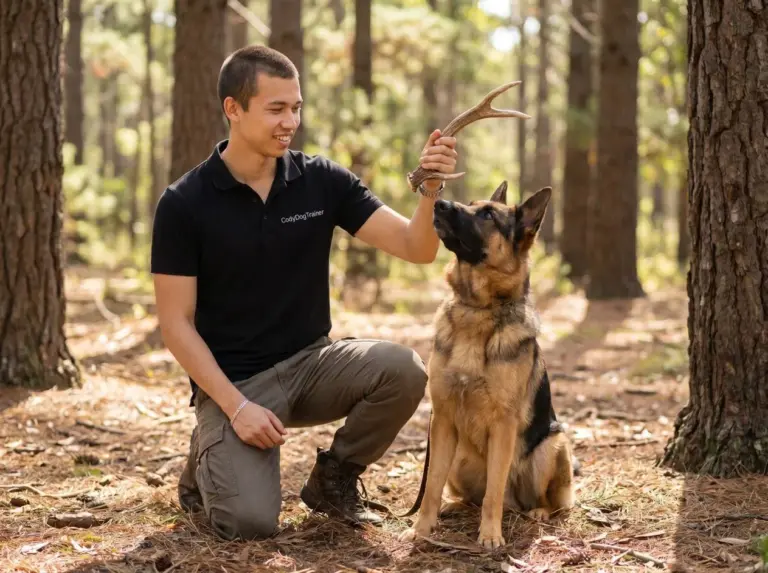
If you’re dealing with a dog that flips from perfect to wild the second prey drive kicks in, I’d rather build that carefully than force a correction and hope it sticks. For a more targeted build-out, I also point people to my shed antler retrieval progression for active wilderness scouting dogs, because that kind of controlled search work teaches a lot about distance, control, and reinforcement under environmental pressure.
The emergency recall has to stay sacred
I train an emergency recall separately from normal recall.
It needs to be:
- distinct
- high-value
- never used casually
- never used when I can’t pay it
I like a whistle or a unique phrase that means, “Drop everything and come now.”
I don’t use that cue to end fun unless I’m ready to pay well for it. If I poison the cue by using it for things the dog hates, I lose the one tool I want most when it matters.
What I tell clients who are stuck
If your dog is “perfect” on a dragging line but fails off-leash, I don’t call that failure. I call it unfinished work.
The fix is usually not more pressure. It’s more honest progression:
- shorter distance
- fewer distractions
- better reward timing
- more off-leash freedom in controlled settings
- no more pretending the line means the dog is ready
Advanced agility is mostly handler language at speed
In agility, the dog is reading my body whether I mean to be communicating or not.
Your shoulders, hips, and feet are part of the cue
Dogs don’t just follow verbal instructions on a course. They read motion.
What I’m doing with my body tells the dog where to go:
- path of motion tells the dog where the line is
- shoulder rotation tells the dog whether to collect or extend
- hip orientation tells the dog where the exit is
- deceleration tells the dog to shorten stride
- arm position helps point the line
If I say one thing and my body says another, the dog usually believes my body.
Why late cues create ugly movement
One of the most expensive mistakes in agility is cueing too late.
If I turn after the dog has already committed to a jump, the dog has to correct mid-air or land off-balance. That’s how I end up with wide turns, poor lines, and more stress on the body than necessary.
I want my cues early enough that the dog can adjust before takeoff.
How I teach better course handling
I teach handlers to think in chunks, not obstacle numbers.
Instead of memorizing “jump 4, tunnel 5, weaves 6,” I want them to see:
- where the side change happens
- where the dog needs collection
- where the dog can extend
- where the tight turn is
- where the commitment point is
That’s more stable under speed.
The course walkthrough should be from the dog’s perspective
When I walk a course, I don’t only walk my own line. I walk the dog’s line.
That changes what I notice:
- where the dog will drift
- where the line is blind
- where I need to cue earlier
- where my body could block or pull
A handler can memorize a course and still run it badly if they don’t understand what the dog sees.
What I do when a dog starts shutting down in trial settings
If a dog freezes, sniffs, or loses drive in the ring, I don’t immediately assume they’re being difficult.
Usually I’m looking at pressure.
The dog may be reading:
- the handler’s tension
- the venue noise
- repeated corrections
- too many failed runs
- the emotional weight of the trial itself
When that happens, I often back off and rebuild confidence. In some cases, I’ll use For Exhibition Only runs so the dog can play in the ring without score pressure. That usually gives me a much clearer picture of whether the dog is stressed, confused, or simply underprepared.
If trial stress is showing up alongside fear, shutdown, or avoidance, I also pay attention to whether I’m dealing with fear or something more defensive. My fear vs aggression in dogs: how to tell the difference piece covers the decision-making I use when the behavior gets blurry.
A real-world handling lesson I keep coming back to
The best agility dogs I’ve worked with were not the ones that could run the fastest in a straight line. They were the ones that could stay organized when the handler’s body got messy.
That’s why I spend so much time on handler movement. The dog is not just performing obstacles. The dog is solving my motion.
Scent work fails when the alert gets more reinforced than the odor
A false alert is often not a scent problem. It’s a training problem.
Why rigid final responses can create false indications
If I force a sit or down at the scent source too early, I can accidentally create a dog that cares more about performing the final posture than finding odor.
That’s where the trouble starts.
A dog can begin offering the alert behavior on fringe odor, empty boxes, or the nearest convenient spot because the posture itself has been heavily rewarded. In other words, the dog is trying to win the game, not necessarily lie in a malicious sense.
I’ve seen this happen when the dog gets frustrated by a hard hide and starts guessing. Once that guessing behavior gets reinforced, it can become a pattern.
How I build odor drive first
I want the dog to love the source before I care about the final indication.
That means I start with simple source work:
- target odor paired with reward
- immediate reinforcement at the hide
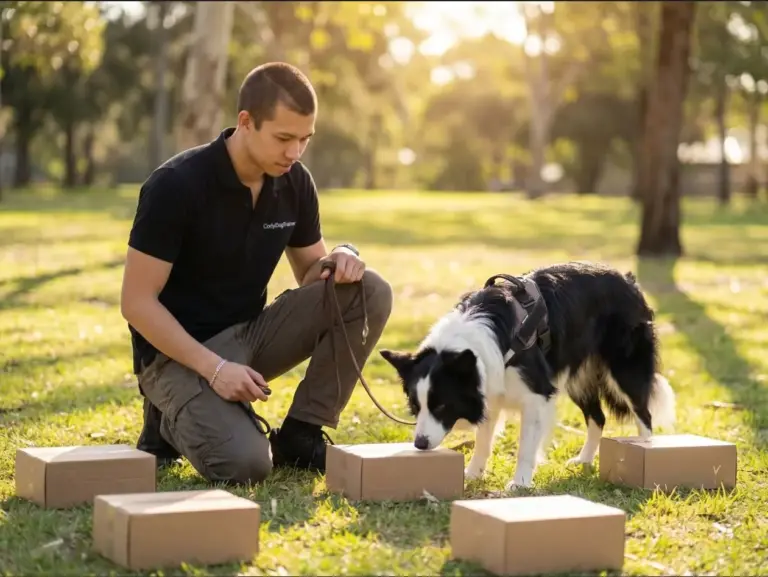
- clean boxes with no confusion
- high success rate before I ask for precision
A useful early tool is the “baby box” setup, where the dog gets continuous reward for finding and staying on source. That builds persistence and clarity.
When I shape the final alert
I don’t rush the final response.
I shape it only after the dog already understands:
- the odor is what pays
- searching is rewarding
- staying with source is valuable
- the game is about odor first, posture second
If I move too fast, I can create a dog that sits beautifully and lies to me when the odor puzzle gets hard.
How I increase difficulty without breaking confidence
Once the dog understands source work, I add challenge in layers:
Elevated hides
This teaches the dog to follow odor plumes, not just floor scent.
Inaccessible hides
This teaches persistence when the dog can’t physically reach the source.
Fringe odor and air movement
This teaches the dog to sort target odor from distractions.
That progression builds a dog that solves problems instead of guessing.
Why this matters in real detection work
Whether I’m working a sport dog, a search dog, or a high-drive nose dog, I want the indication to come from clarity, not frustration.
If the dog is repeatedly false-alerting, I don’t just tighten the alert posture harder. I ask whether I built the search path correctly in the first place.
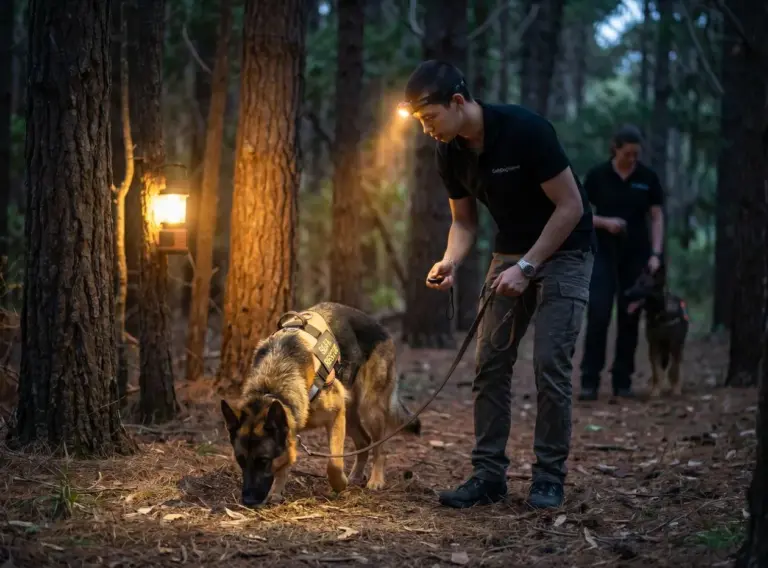
For dogs that need more structured scent exposure in a working context, my how to condition search and rescue dogs for nighttime operations guide is a good example of how I think about environmental layering and confidence under stress.
What people get wrong about advanced training
The biggest mistakes are usually the ones that sound reasonable at first.
“If the dog can do it in training, they should do it anywhere”
Not necessarily. If the dog only knows the behavior in one context, you don’t have a general behavior yet. You have a contextual one.
“More repetition will fix it”
Sometimes repetition just rehearses the wrong version of the behavior. If the dog is failing, I want to know whether the issue is timing, arousal, reinforcement, or environment before I add more reps.
“A harder correction will make it stick”
A stronger correction can suppress a behavior fast, but suppression is not the same thing as understanding. The PLOS ONE e-collar study makes that clear, and I see the same principle in real life all the time: the dog may stop in one setting and fail in another.
“Advanced work is just basic obedience at a higher level”
No. Advanced work adds speed, body mechanics, environmental pressure, and emotional load. The dog’s brain and body are both under more demand.
FAQs
Why does my dog do everything perfectly at home but ignore me outside?
Because the home behavior and the outside behavior are not the same learned picture to the dog. The cue is tied to context, and the new environment may overpower the old reinforcement history. I build reliability by changing one variable at a time: distance, duration, or distraction.
Does agility training improve a dog’s impulse control in everyday life?
Not automatically. The 2025 Animals study found no self-control advantage on a novel detour task for sports-trained dogs versus pet dogs, and barn hunt dogs actually scored lower. If you want everyday impulse control, I train it directly in everyday contexts.
Is a running contact safer than a stopped 2o2o contact?
Not automatically. A 2024 Ciência Rural study found higher Peak Vertical Forces on landing in fast dogs and running contacts compared to stopped contacts. I choose the technique based on the dog, the sport demands, and the physical tradeoffs — not just speed.
How do I know if my dog is overtrained or mentally fried?
I look for slower responses, more sniffing, avoidance, sudden errors in familiar work, and less engagement with the handler. A dog that used to be crisp but now looks flat is often telling me the training load or emotional load is too high.
What’s the best way to build an emergency recall?
I teach a separate cue that is never used casually and is always paid heavily. I build it in low distraction first, then proof it gradually. If I can’t reward it well, I don’t use it.
Why does my dog false-alert in scent work?
Usually because the final response got reinforced before the search behavior was stable. The dog starts chasing the reward pattern instead of the odor. I fix that by rebuilding odor drive and rewarding closer to source.
Can I teach complex tricks faster with shaping or imitation?
Both work, but imitation can be faster for multi-step routines. The 2014 Applied Animal Behaviour Science study found Do as I Do more efficient for complex sequences than traditional shaping. If the dog is socially attentive, I’ll use that.
Should I use a long line forever if my dog won’t recall?
No. I use a long line as a bridge, not a life sentence. It prevents bad rehearsal while I rebuild the recall under controlled conditions. The goal is always to reduce dependence on the line, not create it.
Why does my dog get worse when I ask for more distance?
Distance is one of the three big variables, and it often breaks a behavior before the dog is ready. If distance goes up, I usually lower distraction and keep duration simple until the dog can succeed again.
What’s the best first step if advanced training is falling apart?
Go back to the last point where the dog was successful and identify what changed. Then adjust one variable only. That’s usually where the clean fix starts.
Where to start tonight
If you’re just getting started, pick one behavior and teach it cleanly in one context before you ask for more.
If you’re comparing methods, stop looking for the “best” tool and start looking for the clearest progression for your dog.
If you’re deep in it and nothing is working, simplify the picture: lower the distraction, shorten the session, and rebuild the reward history.
If it worked and then slipped, don’t panic. That usually means the dog learned the behavior in one state and needs help carrying it into another.
That’s the whole point of advanced training as I see it: not just getting a dog to perform, but teaching the dog’s body, brain, and environment to work together. When I do that well, the dog doesn’t just look trained. The dog stays trained.