How To Condition Search And Rescue Dogs For Nighttime Operations
Search and Rescue (SAR) operations often take place in challenging environments, and nighttime conditions can significantly complicate these missions. The effectiveness of SAR dogs is not only reliant on their training during the day but also on their ability to adapt to the unique challenges presented by darkness. This article aims to provide comprehensive guidance on conditioning SAR dogs for nighttime operations, highlighting key training methods, environmental considerations, and practical advice for handlers.
As handlers prepare their canine partners for nighttime operations, understanding the physiological changes that occur in darkness is crucial. Factors such as altered scent dynamics, human movement, and visual distractions must be addressed to ensure that dogs remain confident and effective. This article will explore a phased approach to training, focusing on both the dog’s capabilities and the handler’s role in fostering successful nighttime search operations.
Understanding the Nighttime Environment
The Impact of Darkness on Scent Detection
At night, environmental conditions change dramatically, affecting how scent travels and settles. Solar heating ceases, leading to nocturnal downdrafts that compress scent profiles near the ground. This phenomenon can mislead untrained dogs, as they may track scent that has pooled in low-lying areas far from the actual location of a subject.
Handler Influence on Canine Performance
Handlers must recognize that their own behavior can greatly affect a dog’s performance. In dim conditions, a handler’s reduced visibility can lead to hesitation and clumsiness, which dogs can interpret as a cue to slow down or become anxious. This helps emphasize the importance of handler confidence and movement during nighttime searches.
Phased Training Approach
Stage 1: Indoor Ambient Decrease
The initial stage of training involves acclimating the dog to reduced light environments. This can be achieved indoors where handlers can control the lighting conditions. By gradually decreasing ambient light while maintaining familiar scents, dogs can learn to search effectively without visual cues.
- Execution: Start with full lighting, then slowly transition to dimmed lighting and finally to complete darkness.
- Key Behavior Metric: Dogs should be able to execute a clean alert bark without seeking proximity reassurance from the handler.
Stage 2: Twilight to Dusk Transition
This stage introduces dogs to the natural cooling shifts that occur at dusk. Handlers should conduct searches during the transition from daylight to darkness, allowing dogs to adapt to scent shifting while minimizing distractions from artificial lights.
- Execution: Conduct training sessions starting 30 minutes before sunset and concluding 45 minutes after dark.
- Key Behavior Metric: Handlers should observe changes in the dog’s head carriage as they respond to scent dynamics.
Stage 3: Heterogeneous Visual Distractors
As dogs grow more comfortable in the dark, introducing visual distractions is essential. This helps dogs learn to maintain focus amidst sudden changes in light.
- Execution: Set up a mock search grid where distractions such as vehicle headlights or strobe lights are introduced while the dog is actively searching.
- Key Behavior Metric: The dog must maintain focus on the scent path, disregarding the visual noise from the distractions.
Stage 4: Full Nocturnal Microclimate Deployment
In the final training stage, teams should operate in real-world nighttime conditions, focusing on navigating complex terrains characterized by nocturnal downdrafts.
- Execution: Conduct exercises between 11:00 PM and 4:00 AM in rugged environments.
- Key Behavior Metric: Teams should successfully map and interpret pooling zones, demonstrating trust in the dog’s ability to track scent in low visibility.
Safety and Equipment Considerations
Essential Safety Gear
When conducting nighttime operations, proper equipment is critical to ensure the safety of both the handler and the dog. High-visibility personal protective equipment (PPE) should be utilized without compromising the dog’s olfactory capabilities.
- Reflective Gear: Use vests with reflective piping to enhance visibility without overwhelming the dog’s senses.
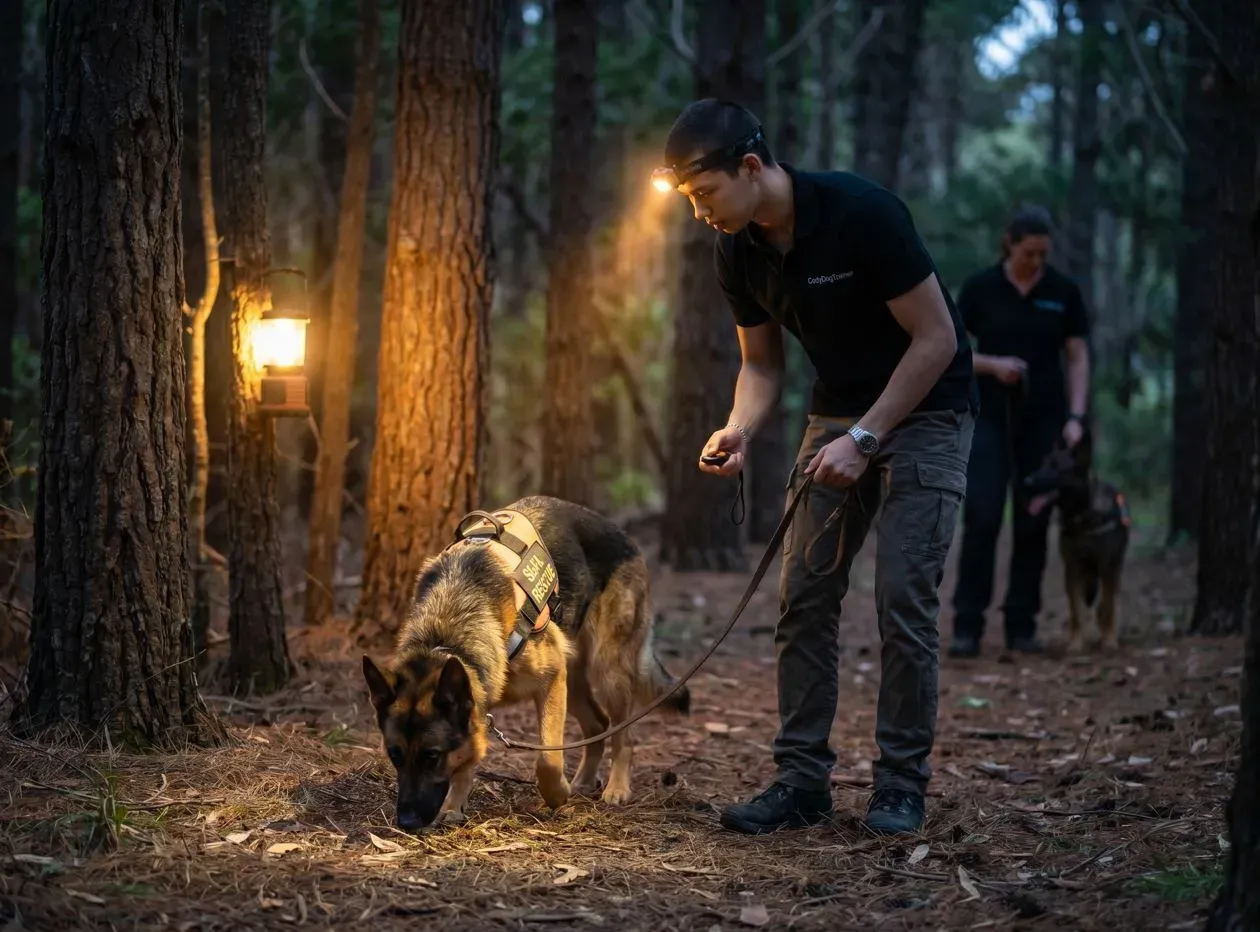
- Low-Intensity Lighting: Employ red or low-intensity green filters on headlamps to minimize visual distractions.
Managing Environmental Risks
Handlers must be aware of the potential hazards that come with nighttime operations, such as hidden obstacles, wildlife encounters, and environmental conditions that can impede both the dog’s and handler’s safety.
- Terrain Awareness: Familiarize the team with the search area to identify potential hazards.
- Wildlife Precautions: Train dogs to remain focused on human scent to prevent distractions from nocturnal wildlife.
Common Challenges and Solutions
Addressing Canine Anxiety
It is common for dogs to experience anxiety in unfamiliar and dark environments. Handlers must work to build their dogs’ confidence through gradual exposure and positive reinforcement.
- Gradual Exposure: Introduce dogs to various nighttime environments slowly, allowing them to acclimate at their own pace.
- Positive Reinforcement: Use rewards to reinforce calm and focused behavior in dark settings.
Visual Distraction Management
Handlers can inadvertently introduce visual distractions through their own equipment or behavior. Awareness and adjustment are necessary to prevent these issues during training and operational scenarios.
- Controlled Training Environments: Conduct training sessions in controlled settings to minimize unexpected distractions.
- Handler Training: Handlers should practice navigation skills in low-light conditions to improve their own confidence and movement.
Frequently Asked Questions
1. Why does my certified air-scent dog suddenly stick to my heels when working at night?
This behavior is often a reflection of the handler’s body language rather than an issue with the dog itself. When handlers exhibit hesitation or tension, dogs may misinterpret this as a warning sign, leading them to stay close.
2. Should I put a flashing or constant LED light on my dog’s vest?
It is advisable to use a low-intensity, shielded beacon focused downward rather than a top-mounted light, which can cause disorientation and hinder performance.
3. How do nocturnal inversions affect how my dog finds a subject?
Nocturnal inversions compress scent molecules near the ground, causing dogs to alert in areas where scent pools are present, which may differ from the subject’s actual location.
4. What kind of training environment is best for nighttime conditioning?
Start in a familiar indoor setting with controlled lighting, then gradually transition to outdoor environments as the dog becomes more comfortable with the dark.
5. How can I build my dog’s confidence in the dark?
Gradual exposure to different nighttime scenarios combined with positive reinforcement will help dogs build confidence and reduce anxiety in dark environments.
Conclusion
Preparing search and rescue dogs for nighttime operations requires a comprehensive and systematic approach that addresses both the canine and handler’s needs. By following a phased training protocol that incorporates environmental acclimation, safety considerations, and visual distraction management, handlers can significantly enhance their dog’s nighttime performance. Continuous practice and adaptation to the unique challenges of darkness will ultimately lead to more successful SAR missions.
To implement these strategies effectively, handlers are encouraged to develop a structured training plan and engage with their canine partners consistently. Building confidence in both the dog and handler is crucial for successful nighttime operations. For further guidance and resources, consider joining SAR training communities or accessing specialized training programs.