Dog Behavior Training: The Complete Guide to Fixing Common Behavior Problems
Dog behavior changes when the nervous system changes. If a dog is panicking, guarding, lunging, or barking from survival stress, obedience alone won’t fix it — you have to get the dog back into a state where learning can happen.
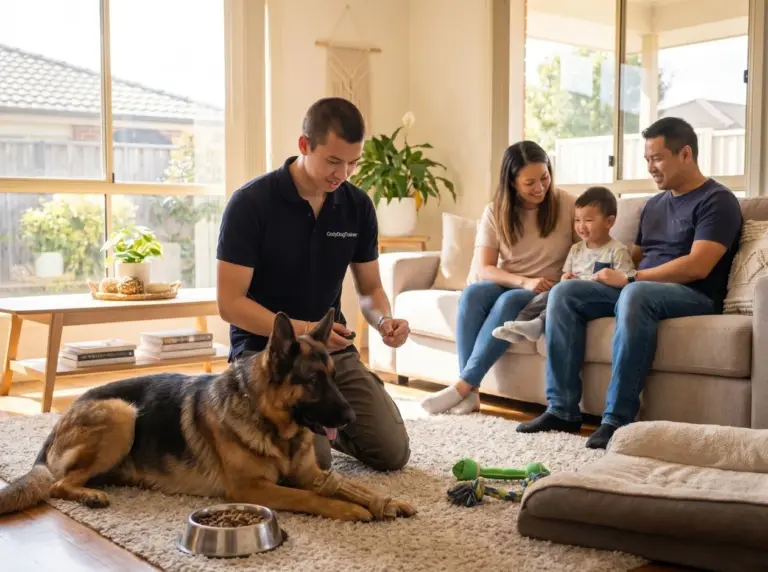
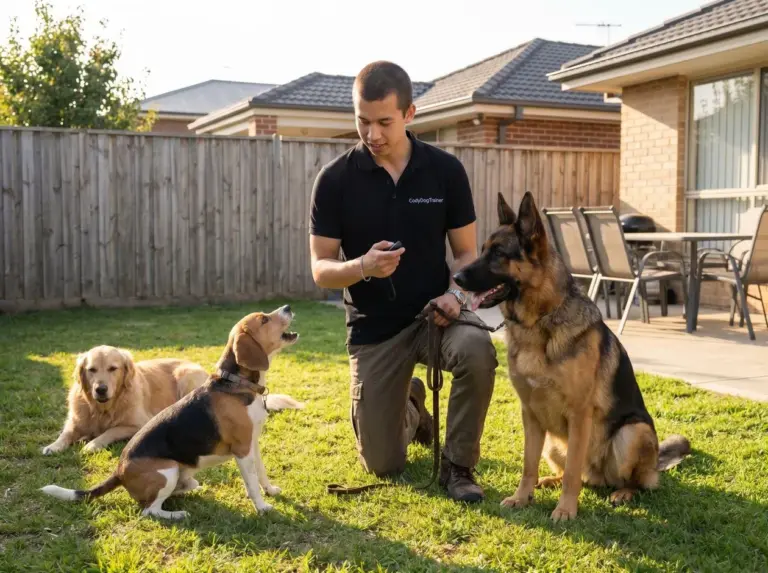
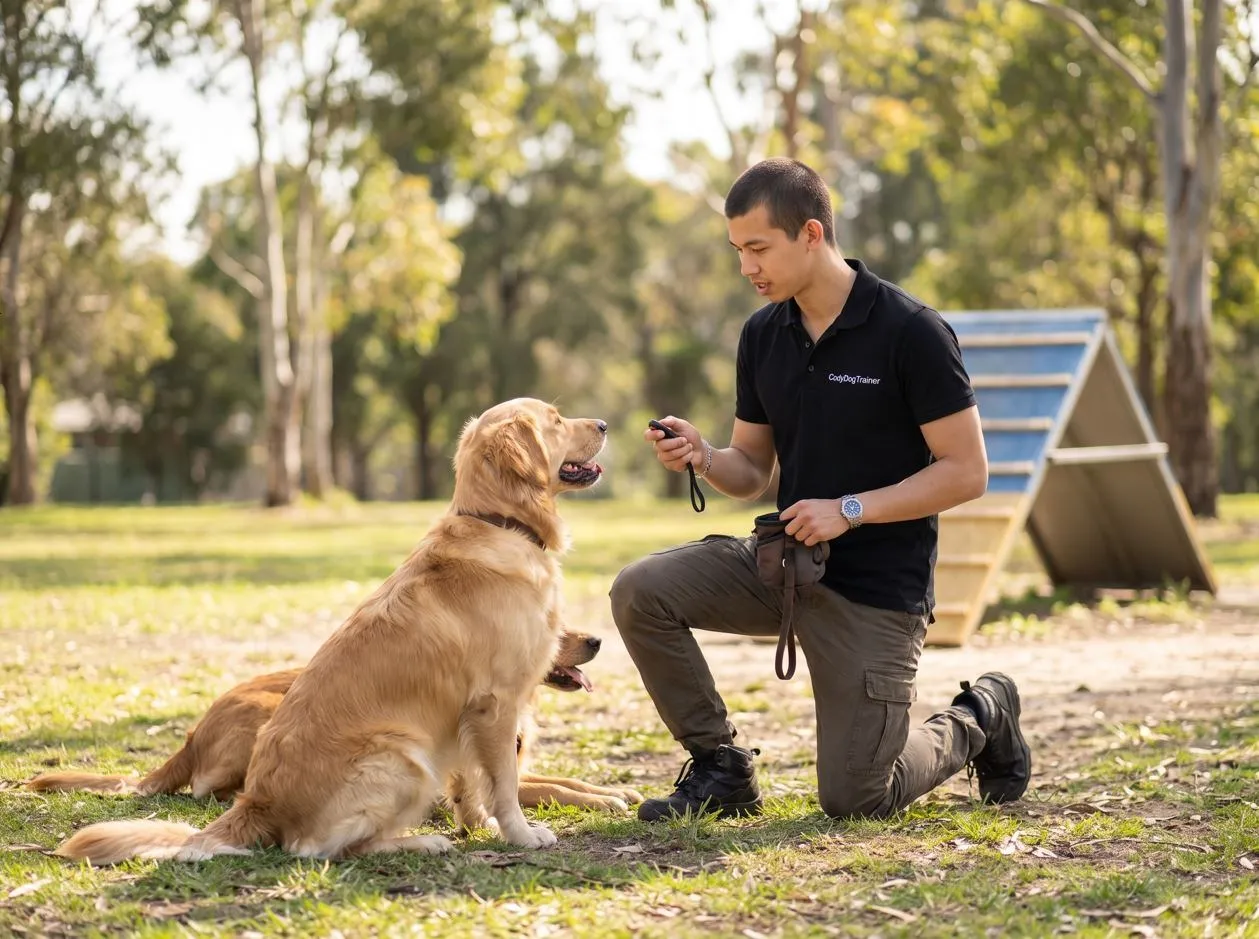
This page exists to give you the big picture: what behavior training actually is, why so many common fixes fail, and how I approach real cases in the field. After 10 years working with dogs in homes, rescues, and training settings, I’ve learned that the fastest way to improve behavior is usually not “more commands,” but better state management, better timing, and better handling of the environment.
What dog behavior training actually fixes
Dog behavior training fixes the dog’s response to stress, not just the visible symptom.
That means I’m not only looking at the barking, lunging, biting, guarding, or panic. I’m looking at what state the dog is in when the behavior happens, what the trigger is, what the dog has learned from the environment, and what the handler is accidentally reinforcing.
In practice, behavior training is about changing the dog’s emotional prediction: “Is the world safe?” “Is my food safe?” “Is this person safe?” “Will I be trapped?” “Will I be dragged?” When those predictions change, the behavior changes with them.
Behavior training is not the same as basic obedience
Basic obedience teaches skills like sit, down, stay, and recall. Those skills matter, but they are not the same thing as changing fear, frustration, or defensiveness.
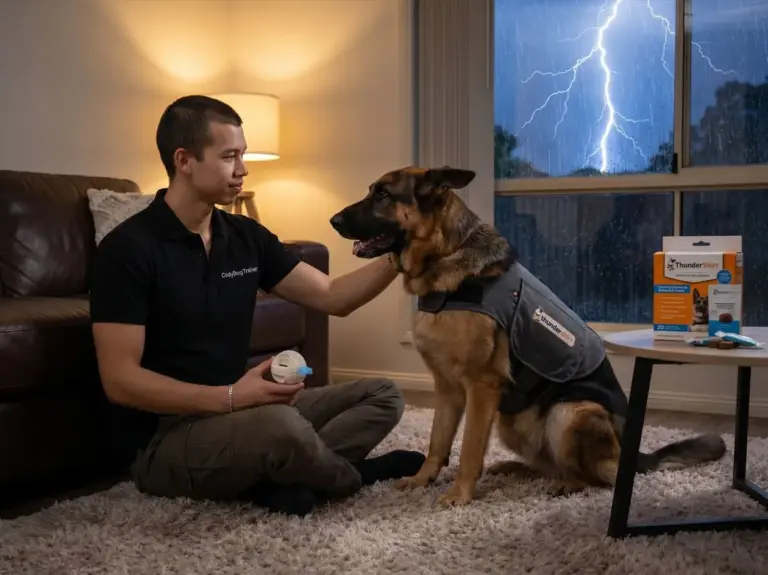
A dog can know “sit” and still panic at a thunderstorm. A dog can heel and still explode at the end of the leash. A dog can “leave it” in the kitchen and still guard food from a family member. If the nervous system is over threshold, the command may be known but unavailable.
That’s why I treat behavior training as a state problem first and a skill problem second.
The three states I watch for
- Ventral vagal / socially available: the dog can notice, think, and learn.
- Sympathetic / fight-or-flight: the dog is reacting, lunging, barking, pacing, or grabbing.
- Dorsal vagal / shutdown: the dog looks quiet but is actually overwhelmed, frozen, or collapsed.
That distinction matters because a quiet dog is not always a calm dog. A shut-down dog may look “good” to an inexperienced eye while being deeply stressed underneath.
If you want the deep dive on one of the most common state-driven issues, read my complete guide to how to calm an anxious dog during thunderstorm events.
Why top-down obedience fails hyper-aroused dogs
Top-down obedience fails because a dog in survival mode is not processing the world like a relaxed dog.
When a dog is panicking, defending, or over-aroused, the cognitive part of the brain has less access. That’s why “sit” often falls apart in the exact moment you need it most. The dog is not being stubborn. The dog is already past the point where a simple cue can reorganize the internal state.
What people get wrong about “training through it”
One of the biggest mistakes I see is owners trying to override stress with repetition. They keep asking for the behavior they want while ignoring the state that makes the behavior impossible.
That’s why harsh corrections often backfire. They may suppress the outward behavior for a moment, but they usually increase internal pressure. In fearful dogs, that pressure comes back as more reactivity, more guarding, or a bigger blow-up later.
According to the comparative welfare research published in PLOS ONE, dogs trained with aversive methods show more stress behaviors, higher post-training cortisol increases, and more pessimistic cognitive bias outside training. That matches what I see in real dogs: punishment may stop the symptom for the moment, but it rarely builds confidence.
Why “more exercise” is not the answer
Exercise helps many dogs, but it does not fix nervous system dysregulation by itself.
I see this mistake constantly with barking, pulling, and reactive dogs. Owners exhaust the body but never lower the arousal. The dog comes home physically tired and neurologically wired. That’s how you get a trigger-stacked dog: tired legs, high stress, and no real recovery.
For barking cases in particular, I go much deeper than “wear them out.” If that’s the issue you’re dealing with, start with my guide to solutions for excessive barking in multi dog suburban homes.
Cody’s Pro Tip: If your dog gets worse after a long walk, that’s a clue, not a failure. I’d rather see a 15-minute decompression walk with space, sniffing, and slack leash than a 90-minute chaos walk that leaves the dog more reactive than before.
The Autonomic State Modulation framework I use first
Autonomic State Modulation is the framework I use to bring a dog back into a learning state before I ask for behavior change.
I use it in three phases: somatosensory discharge, relational anchoring, and environmental integration. The order matters. If you skip the first two and go straight to cues, you’re often trying to train a dog whose body is still in alarm mode.
Phase 1: Somatosensory discharge
This is where I help the dog vent accumulated tension in a structured way.
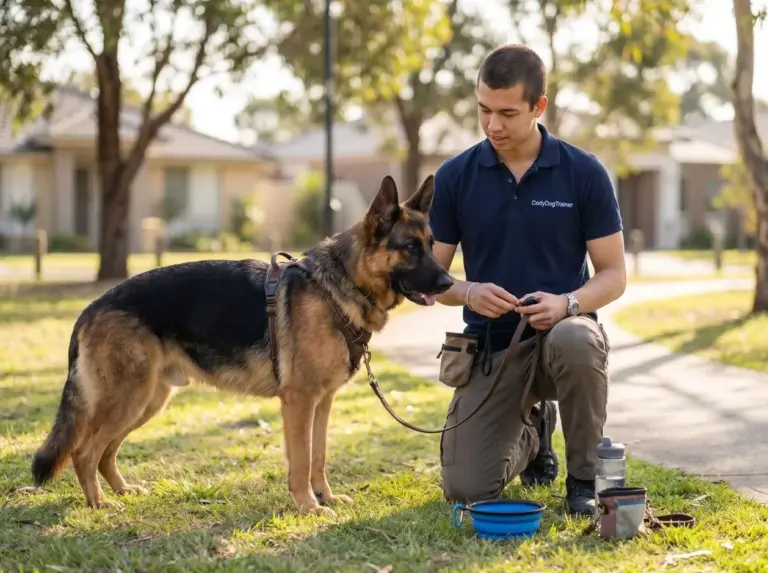
For many dogs, that means low-arousal sniffing, slow decompression walks on a long line, and movement that lets the body settle without pressure. I’m not looking for exhaustion. I’m looking for a visible drop in muscle tension, scanning, and reactivity.
Phase 2: Relational anchoring
Dogs read people constantly. They read breath, posture, pace, voice, and tension in the leash.
When I work with a dog, I make my own body boring on purpose: slower steps, quiet hands, softer shoulders, and deliberate breathing. I want the dog to feel a stable partner, not another source of pressure.
This is especially useful for dogs that get escalated by handler tension. A dog that explodes when physically pulled back is often reacting to the leash pressure itself, not just the trigger ahead.
Phase 3: Environmental integration
Only after the dog is calm enough to think do I add controlled exposure to the trigger.
That might mean seeing a visitor from a distance, hearing thunder at a low volume, passing another dog far enough away to stay under threshold, or being near food without feeling pressure around it. The dog learns safety first, then behavior.
That same logic is why I handle food aggression with distance and trust-building instead of bowl intrusion. If you need that full process, read my guide on counter conditioning procedures for food aggression in multi dog households.
Cody’s Pro Tip: Before you start a session, check your own body. If your shoulders are tight and your leash hand is fixed, your dog feels that. I tell clients to take one slow breath before opening the door, then another before asking for anything.
Why leash pulling, barking, and reactivity feed each other
Leash pulling, barking, and reactivity often sit in the same loop because pressure creates pressure.
When a dog hits the end of the leash, the body gets physically blocked. That can trigger opposition reflex, frustration, and defensive arousal. If the handler then braces harder, the dog often pulls harder. If the dog is already anxious, the whole exchange becomes a feedback loop.
Why pulling back can make lunging worse
Many owners think they need to physically pull the dog back into position. In a reactive dog, that can be exactly what sets off the explosion.
Mechanical tension can act like a trigger. It changes body balance, adds restraint, and can turn a curious dog into a dog that feels trapped. Once the dog feels trapped, the nervous system often answers with fight-or-flight.
That’s why I prefer equipment and handling that reduce tension instead of amplify it. If your dog pulls so hard it seems to choke, start with my article on what to do when a dog pulls so hard it can’t breathe.
What I change before I change the walk
- I stop using a tight, constant leash.
- I create more physical space from triggers.
- I use sniffing and pattern work to lower arousal.
- I reward slack moments, not just perfect heeling.
That approach helps more dogs than a hard heel ever will, especially if the dog is already anxious or frustrated.
Small dogs and large dogs need different handling
Small dogs often get over-handled because people think they need to be “controlled” more tightly. Large dogs often get overpowered because owners are scared of what happens if the dog surges.
In both cases, the answer is not more force. The answer is better mechanics, better distance, and better timing. A dog that can move without feeling trapped usually learns faster.
Cody’s Pro Tip: If a dog is frozen on leash, don’t immediately drag them forward. I usually pause, soften my body, create a little slack, and let the dog reorient before I ask for movement again. That small change can prevent a full lunge.
What I watch for first in real training sessions
Before I change behavior, I look at the dog’s baseline state, the handler’s mechanics, and the environment.
That is usually where the real problem is hiding. The behavior itself is the last thing I look at, not the first.
A real pattern I see often
I worked with a mixed-breed adult dog that would lunge at every passing dog on neighborhood walks. The owner had been told to “correct the leash pop” and “make him heel.” It only made the dog more explosive.
What changed the case was not more force. We switched to lower-pressure walks, widened distance from other dogs, stopped rehearsing the end-of-leash conflict, and built a predictable pattern the dog could trust. Within a few weeks, the dog started scanning less and recovering faster after triggers.
That is the kind of case that reminds me behavior change is often about reducing threat, not winning a contest of will.
What I assess in the first 10 minutes
- Does the dog recover quickly after a trigger?
- Is the dog eating normally or too stressed to take food?
- Does the dog move fluidly or look stiff and guarded?
- Does the handler tighten up before the dog reacts?
- Is the environment too close, too loud, or too crowded?
If I can lower arousal in the first session, I usually know the plan is workable. If the dog cannot settle at all, I start thinking about medical support, environmental management, or a slower entry point.
For dogs that panic when left alone, the same first-look rules apply. I do not start with a rigid crate schedule if the dog is already panicking. I start with the environment and the dog’s ability to stay under threshold. If that is your situation, read my guide on how to calm an anxious dog during thunderstorm events for the same state-based logic applied to noise anxiety.
How I handle separation anxiety, resource guarding, and food aggression
These problems look different on the surface, but they all come back to safety.
Separation anxiety is fear of absence or isolation. Resource guarding is fear of loss. Food aggression is often fear of approach or theft. The training goal is not to “show the dog who’s boss.” The goal is to change the prediction that people or events make life less safe.
Separation anxiety: the single-owner problem
One of the hardest cases I see is the single working owner who is told they must never leave the dog alone during desensitization. That advice is unrealistic and usually collapses in real life.
Instead, I build an interim absence plan. That can include low-cost sitters, dog daycare that is actually a good fit, baby-gated safe spaces, and non-linear absence practice that does not force the dog through panic. The point is to prevent rehearsal of full panic while still allowing the owner to live normally.
If this is your situation, the deep dive is how to calm an anxious dog during thunderstorm events, which covers the same nervous-system logic for panic states.
Resource guarding: why trust beats intrusion
I do not recommend sticking hands in a dog’s bowl to “prove” anything. That approach teaches the dog that humans come near food and take things away.
What I want instead is safety. Feed in a separate area if needed. Toss better food into the bowl from a distance. Build a history where human approach predicts good things, not loss. Then I can work on trades, handling, and calm presence.
If the dog guards food around other dogs, the environment needs even more structure. Read my full guide to counter conditioning procedures for food aggression in multi dog households and my article on how to stop resource guarding behavior around family members.
Food aggression in multi-dog homes
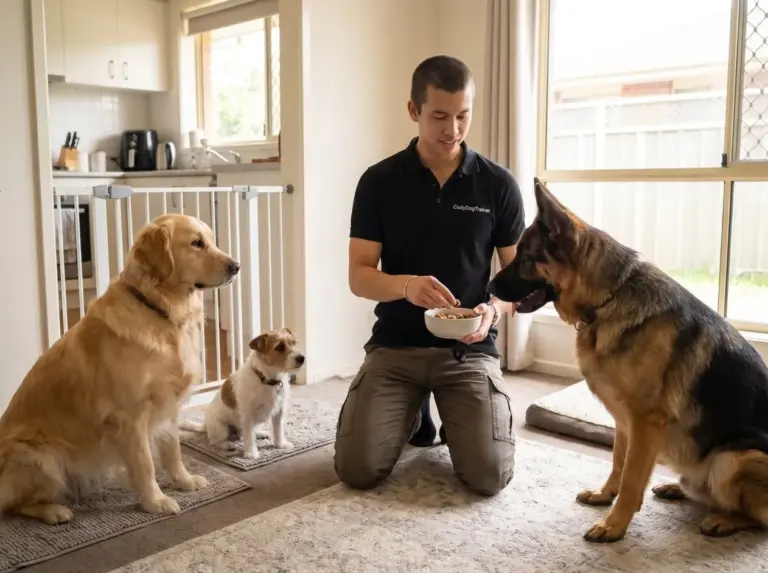
Multi-dog feeding problems are not solved by hoping the dogs “work it out.” I treat food as a managed resource.
That means separation, clear feeding zones, predictable routines, and no opportunities for competition. Once the dog feels safe, I can layer in counterconditioning. But the first move is always management.
Excessive barking in shared homes
In suburban or multi-dog homes, barking often comes from alerting, frustration, or social contagion. One dog starts, the others join, and soon the whole house is rehearsing arousal.
I address the trigger, the routine, and the reinforcement pattern. If you want the full breakdown, read solutions for excessive barking in multi dog suburban homes.
Cody’s Pro Tip: If guarding is happening, stop testing the dog. Testing is not training. I’d rather see a dog eat safely behind a gate for two weeks than “prove” they can tolerate a hand in the bowl and risk a bite.
Puppy behavior training vs. adult dog behavior training
Puppies and adult dogs need different strategies because their brains, sleep needs, and impulse control are different.
Puppies are not miniature adults. A lot of what looks like “bad behavior” is actually exhaustion, over-arousal, or underdeveloped self-regulation. Adult dogs bring history with them, which means I have to think about learned patterns, not just development.
Puppy biting is often an arousal problem
Many owners try yelping or high-pitched corrections when a puppy bites. In my experience, that often makes things worse, especially in high-drive puppies. The sound can excite the dog, not calm them.
What works better is removing reinforcement, creating a short timeout, and protecting sleep. Puppies need enforced rest, not endless stimulation.
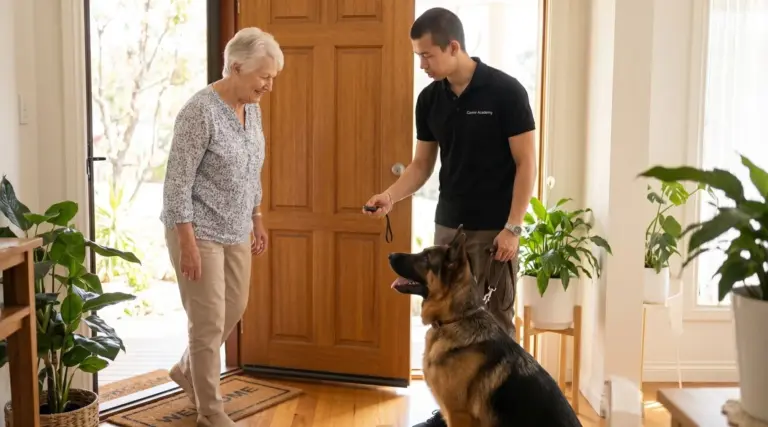
If your puppy is biting hard, read my guide to solutions for habitual jumping behavior on elderly home visitors for one piece of the broader impulse-control picture, and pair it with a structured puppy routine at home.
Forced naps matter more than people think
Sleep deprivation can make a puppy look defiant, mouthy, and wild. Often the puppy is not being difficult; the puppy is overtired and dysregulated.
I like predictable rest blocks, quiet spaces, and a routine that prevents the puppy from tipping into chaos. That alone can transform behavior faster than a dozen corrections.
Adult dogs usually need history-based work
Adult dogs often have a rehearsal history. They’ve practiced pulling, barking, guarding, or panicking enough times that the pattern is entrenched.
That means I have to change the environment, the timing, and the dog’s expectations. I’m not just teaching a new cue. I’m rewriting a habit loop.
Age and severity change the plan
- Mild puppy issues: management, rest, and simple reinforcement changes.
- Severe adult reactivity: distance work, state regulation, and careful trigger exposure.
- Multi-dog homes: structure first, training second.
- People-sensitive dogs: safety and predictability before handling.
That’s why I don’t give every dog the same plan. The dog in front of me decides the pace.
Cody’s Pro Tip: If a puppy is biting harder after you redirect with a toy, don’t assume they need a better toy. They may need less stimulation and more sleep. I see that more often than people expect.
When behavior training is not enough
Sometimes the right answer is training plus veterinary support.
If a dog is so anxious, reactive, or shut down that they cannot stay under threshold long enough to learn, medication may be part of the humane plan. That is not a shortcut. It is sometimes the thing that makes learning possible.
When I recommend a veterinary behaviorist
I start thinking about referral when I see severe panic, self-harm, persistent shutdown, or aggression that escalates despite good management and careful training.
That can also apply when the dog seems unable to process any exposure work without spiraling. In those cases, a veterinary behaviorist can help lower the baseline anxiety enough for training to work.
The JAVMA data showing how common separation anxiety is, combined with the low percentage of owners who seek behavioral guidance, tells me a lot of dogs are struggling longer than they need to before getting the right help.
Why medication can help learning
Medication does not replace training. It can reduce the intensity of the survival response so the dog can actually access the learning window.
That matters for dogs with chronic panic, severe thunderstorm fear, intense guarding, or deep reactivity. When the dog can finally stay below threshold, the behavior work starts to stick.
If you’re dealing with storm panic specifically, I’d start with how to calm an anxious dog during thunderstorm events, then talk to your vet if the fear is severe enough that the dog cannot recover.
What not to do
- Do not punish panic.
- Do not force repeated exposure at full intensity.
- Do not assume a quiet dog is a calm dog.
- Do not use dominance language to explain fear.
Fear is not a character flaw. It is a physiological state, and the training plan has to respect that.
Frequently Asked Questions
How long does dog behavior training take?
It depends on the behavior, how long it’s been rehearsed, and how consistent the environment is. Some dogs improve in a few sessions when the issue is mostly management and timing. Others need weeks or months, especially if the behavior is rooted in fear, panic, or long practice history.
Can I fix behavior problems without punishment?
Yes, and in many cases punishment makes the problem worse. I get better results when I change the dog’s environment, lower arousal, and reinforce the behavior I want instead of trying to suppress the behavior I don’t want.
Why does my dog behave at home but fall apart outside?
Home is usually a lower-stress environment with fewer triggers. Outside, the dog may be dealing with noise, movement, smells, distance, and social pressure all at once. That’s why training has to start where the dog can still think.
Is barking always a training problem?
No. Barking can be alerting, frustration, boredom, anxiety, or social response. The fix depends on the reason behind it. If you treat every bark the same way, you usually miss the real cause.
Should I use a crate for separation anxiety?
Only if the crate is genuinely safe and calming for the dog. If the dog panics in the crate, forcing more crate time can make things worse. Some dogs do better in a proofed room or gated area where they feel less trapped.
Can an older dog still change behavior?
Absolutely. Older dogs can learn new patterns, especially when the training reduces stress instead of adding pressure. I may move slower, manage the environment more carefully, and keep sessions shorter, but age alone is not a reason to give up.
What’s the fastest way to stop leash pulling?
The fastest reliable fix is usually not a correction. It’s reducing tension, rewarding slack, and giving the dog a better way to move through the environment. If the dog is also reactive or anxious, the walking plan has to address that first.
Where to Start This Week
Behavior changes fastest when you stop treating the symptom like the whole problem and start working with the dog’s nervous system.
If you do one thing this week, pick the biggest trigger in your house or on your walks and lower the intensity before you ask for better behavior. That might mean more space, a calmer routine, separate feeding, a different leash setup, or shorter sessions with better timing.
If you want the most practical next step, start with the issue that is costing you the most stress right now: my complete guide to leash pulling that’s so severe it affects breathing. If you need hands-on help beyond that, I’d rather look at your dog in context and build a plan that fits your life than give you a generic fix that falls apart by day three.